

The 22nd annual Mount Alexander Schools Chess Challenge will be held at Castlemaine Secondary College on September 15, but the tournament has already begun in a sense.
Not on the chessboards perhaps, but in the minds of the students preparing for it. Over the next eight weeks, Castlemaine Secondary College is trialling an innovative Chess Mentoring Program in three local primary schools.
The initiative is led by CSC teacher Mark Johansson, assisted by a team of enthusiastic secondary students who are discovering that teaching can be every bit as challenging as remembering where you left your queen.
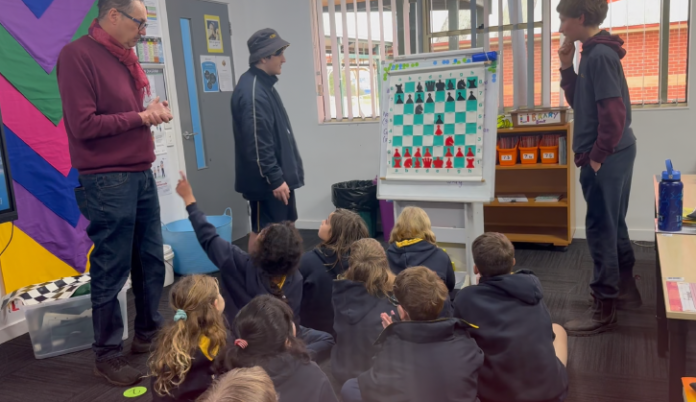
Johansson, together with CSC student mentors Edward Harris and Michael Miles recently visited Campbells Creek Primary School to introduce students to the mysteries of the opening moves.
Former local teacher, chess mentor and advocate, Kevin Brown said it was an encouraging sight.
“Seeing experienced players guiding younger ones through a game where every move has consequences, rather like deciding whether to tell your parents you’ve finished your homework before they’ve asked.
“Mark shared a fascinating statistic with the students. Within the first eight moves of a chess game—four by White and four by Black—there are 318,979,564,000 possible move sequences, or nearly 319 billion ways to begin a game before anyone has even agreed on what ‘a simple opening’ means.”
It seems unlikely the mentoring program will cover all of them in eight weeks, though one suspects some education departments may still request a progress report. The remarkable complexity of chess explains why it has earned a respected place in many schools’ mathematics programs.
“Every game encourages students to think logically, recognise patterns, visualise spatial relationships and solve problems several moves ahead. In other words, it develops exactly the sort of thinking that proves useful in mathematics; and occasionally in deciding who gets the last sausage roll,” Brown said.
“Perhaps the greatest strength of the program is that it extends well beyond the chessboard. Primary students gain confidence from working alongside older mentors, while the CSC students develop leadership, communication and patience.
“Explaining why a knight moves in an L-shape to an eager Year 4 student is excellent preparation for almost any future career,” Brown said.
“By the time the Mount Alexander Schools Chess Challenge begins in September, not every student will become a chess champion. But they will all have practised thinking carefully, planning ahead and learning from their mistakes. And if they can master those skills while remembering there are still 318,979,563,999 opening variations left to explore, they’re already well ahead of the rest of us.”