

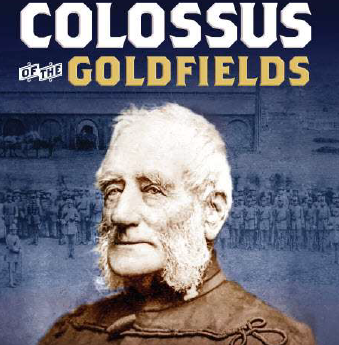
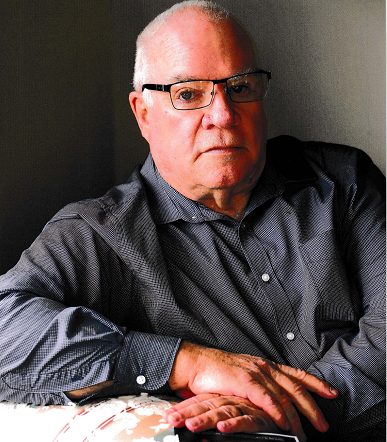
Castlemaine Society Inc invites community members to the launch of a fascinating new biography on the life of Colonel John Edward Newell Bull by Goldfields Police and Military historian Dr Bob Marmion.
The book will be officially launched this Sunday August 30 at the historic Castlemaine Market Building.
The book follows years of painstaking research by the noted historian.
Dr Marmion said Bull was a soldier, statesman, visionary and goldfields civic leader.
“This is the story of a man who had possibly the greatest impact of all on the Victorian goldfields during the 19th century,” he said.
Born in 1806 in Ireland, John Edward Newell (JEN) Bull was the son of a British Army officer. His father, Colonel Robert Bull, distinguished himself at the Battle of Waterloo in 1815. His actions no doubt inspired young John.
After training at the Royal Military Academy, Sandhurst, John was commissioned into the British Army, serving in both the UK and Ceylon. In 1842 he was in charge of a shipload of convicts being transported to Tasmania.
He was a British Army Imperial officer, initially in the 78th Regiment of Foot and then with the 99th Regiment of Foot from 1842 through to 1849 when he resigned his commission. Whilst with the 99th, and later in private life, he was responsible for major engineering and road works at Newcastle and in the Blue Mountains in New South Wales. His troops and convicts played a major role in building the main western road between Sydney and Bathurst across the Blue Mountains.
After leaving NSW in 1852, he went onto have a stellar career on the central Victorian goldfields, initially at Bendigo and then at Mount Alexander.
“He was a real man of the times – Imperial soldier, social reformer, engineer, magistrate, goldfields administrator. He was Goldfields Commissioner and later Warden in charge of the Mount Alexander goldfield, based on present day Castlemaine, which at the time was the largest in Victoria,” Dr Marmion said.
“He was a major player in establishing Castlemaine including being involved in the setting up of the mining and police courts, the rifle club, the Volunteer Rifles, the Hospital, Benevolent Asylum, Mechanics Institute, agricultural societies, schools, and the municipal council, etc.
“He was involved in over 30 different organisations in Castlemaine; in fact, I am surprised when I come across an organisation that he was not involved in,” Dr Marmion said.
Whereas the poor treatment of the miners in Ballarat led to the Eureka Stockade in December 1854, Bull handled the troubles at Mount Alexander in a completely different way. Instead of opposing the miners, he talked to them and settled many of their grievances thus avoiding bloodshed.
Though he was a Goldfields Commissioner and later Warden and Police Magistrate, he was held in very high regard by miners and the general community. It was because of this high regard and his ability to talk to and be trusted by the miners, which prevented open rebellion on the Mount Alexander goldfields in 1853 – a year before the Eureka outbreak.
“If the Ballarat authorities had taken a leaf out Bull’s play book, Eureka may never have happened,” he said.
Bull and his family originally lived in the Goldfields Commissioner’s House (5 Yandell Street, Castlemaine) before moving out to land near the present-day Castlemaine Rifle Club in the early 1870s. His house, Glencairn, burnt down in 1897 and JEN moved to Goulburn, New South Wales, to
live with his daughter. He died there in 1901.
This biography traces his life from his early days through to his death.
“I look at the highs and the lows including his various legal problems such as insolvency and the imprisonment of his son for fraud. Of major importance is his impact on administering the central goldfields during very tumultuous times,” the author said.
Whilst on the face of it, JEN Bull was a product of the conservative establishment in England. He came from a family with a strong Anglican background, with his upbringing reinforced by a proud military tradition as a result of his father’s exemplary service in the British Army during the
Napoleonic Wars. This clearly influenced JEN’s choice of career, as it did two of his brothers.
When the miners on the Mount Alexander and Bendigo goldfields began to ‘rebel’ in August 1853, Bull realised that it was not a rebellion against the establishment, but rather a protest about the conditions on the goldfields, in particular the dreaded licence fee, rampant crime, police corruption
and the lack of representation in government. By taking a conciliatory manner, Bull talked to the miners and addressed their concerns.
“Bull clearly had a vision for Castlemaine to become a major inland centre in Victoria. As outlined earlier, he was a major player in setting up the institutions that would make up the town. A clear example was his role in the formation of the local Volunteer Rifle Corps as a way of firstly reinforcing a society built on British norms and secondly providing a sense of security on the goldfields that did not involve the hated redcoats from the Eureka days,” Dr Marmion said.
As the Goldfields Commissioner he had to balance the needs of the emerging townsfolk versus the demands of the mining community. When the latter, by introducing puddling machines which began to foul the town’s waterways, Bull immediately adopted the role of environmental warrior and banned the puddling machines.
Despite the fact that he was later overruled by Melbourne, it still shows that he was prepared to make hard decisions in the best interests of the town.
“Bull was a man of vision who had the ability to make things happen. Even though he had a number of misfortunes in his private life, his sense of duty and commitment to Castlemaine remained with him until his final years.”
The book launch will take place at the historic Castlemaine Market Building, 44 Mostyn Street at 2pm.
Guest speaker will be celebrated local historian Dr Marjorie Theobald.
Entry is free, but registrations are encouraged to assist with catering purposes via Humantix.