
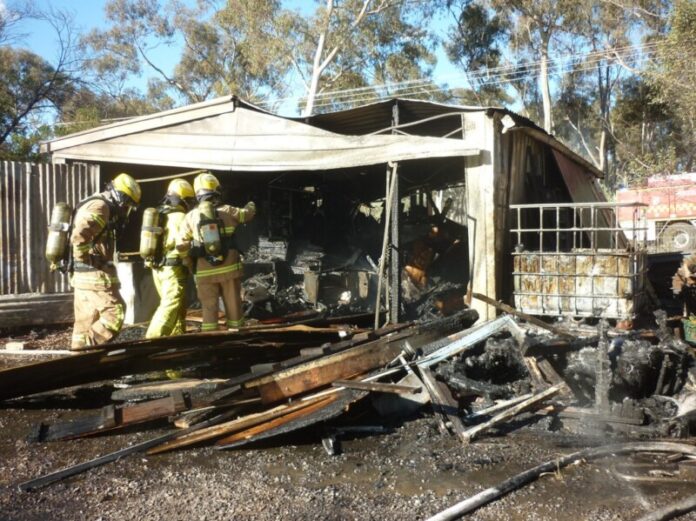
Newstead Fire Brigade member Christopher Simmins was among the crews to turnout to a shed fire at Newstead on Tuesday evening and shared the following account of this incident.
It was a warm still evening at Newstead on Tuesday January 6.
My battered CFA pager sprung to life … quickly startling me from my slumber… ‘Structure fire Wyndham Street Newstead’. I paced smartly to the car, then slipped promptly into my grubby CFA gear. Heading down to the station, a column of tall black smoke effortlessly rose above the treetops, piercing into the clear blue sky. It gave a good signal as to the fire’s location. Damn I thought, it’s in the heavy bush area of Newstead … the smoke quickly changed colour.
Within moments, Newstead Fire Brigade trucks and crews were on scene battling a well stacked storage shed that contained plenty of wood and building products. The initial conflagration presented the firefighters with a red hot roof and side walls. The fire’s point of origin was at the rear corner of the shed, which had begun to sag. The initial heat was immense as fire fighters wearing breathing apparatus pounded the structure with multiple heavily charged fire hoses. Neighbours stared in shock and disbelief as to speed the fire took hold. Newstead crews quickly controlled the job while protecting surrounding structures.
Newstead Brigade was ably assisted by Maldon, Castlemaine and Franklinford Brigades.
As to cause… I later quizzed the owner on possible heat or ignition sources that may have triggered the fire. After eliminating the usual suspects… batteries left on charge, electrical equipment left unattended, hot grinding dusts etc, paints solvents, pressure pack cans were mentioned, the owner said he had been using Tung Oil and some cleaning rags earlier in the day. He had been using them near the fire’s point of origin.
The main fire concern with using Tung Oil does not come from the liquid in the can, but from the rags, steel wool, or paper towels used during application.
Tung Oil, being a drying oil, cures through a chemical reaction called oxidation, where it absorbs oxygen from the air to harden. This process is exothermic, meaning it generates its own heat as a byproduct. When an oil-soaked material, such as a crumpled rag, is placed in a pile, the generated heat becomes trapped because the material acts as insulation. If this heat cannot dissipate into the air, the internal temperature of the bundle can rise rapidly. This self-heating process continues until the material reaches its autoignition temperature, causing the rag to ignite without any external spark or flame. This is the mechanism of spontaneous combustion, and Tung Oil poses a high risk for this reaction.
The internal fire was brought under control about an hour later. It was also fortunate that the wind conditions on the day were ‘dead calm’.