
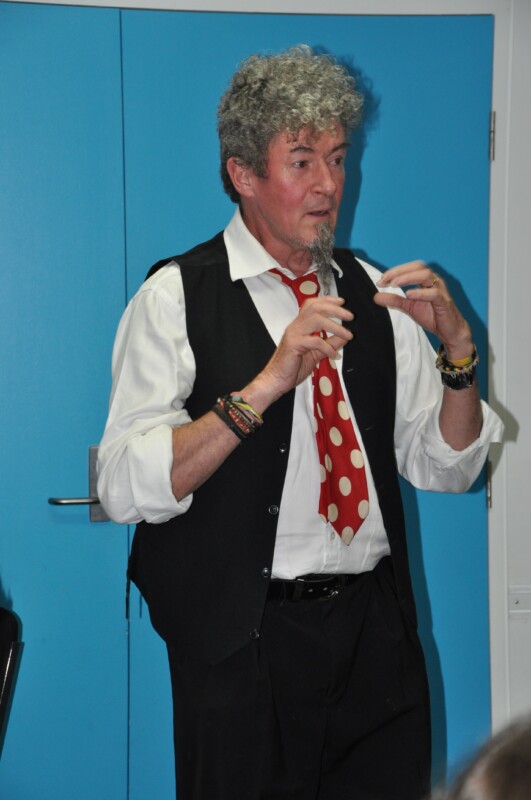
Jade Jungwirth
“I think teaching is the most important job in the world – it is a privilege to stand in front of a classroom and say, ‘You’ve got to change the world – you’ve got a big job to do, and I want to help you get ready for that.'”
After half a century in education, teacher and artist Ken still lights up when he talks about the classroom.
Last Sunday, Ken was recognised for 50 years of service to the Victorian Education Department at a ceremony held at Pullman on the Park in East Melbourne — a milestone few teachers ever reach.
Despite officially spending 45 years in the classroom, Ken’s teaching career began five years earlier when he began studying.
“I got a studentship, so the Education Department paid me to go to university, because they were short of teachers. I was bonded to be a teacher in the technical school for two years,” he said.
Ken completed a three-year diploma in fine art and spent several years developing his own arts practice as part of his agreement to work at the technical school.
He worked in nurseries in the Grampians and then in Bendigo, while exhibiting drawings in galleries across Melbourne, Adelaide, and Canberra.
One early exhibition at Richmond’s Christine Abrahams Gallery proved a career-defining moment.
“I sold everything, including to the National Gallery of Victoria, which was pretty exciting.”
His drawings also earned him finalist spots in the prestigious Faber-Castell Drawing Prize, and many of the works that he exhibited were bought by Artbank.
Ken’s first teaching post was at Mooroolbark Tech in 1980, before being transferred to Hamilton Tech — his twelfth preference on a list of schools offering senior art programs.
He stayed for five years and then applied for a job in Castlemaine – he arrived in 1986 and never left.
At the time, the town’s arts scene was flourishing. Artists were moving to the region in large numbers, and the Castlemaine Technical School’s T.O.P (Tertiary Orientation Program) was considered one of the best in Victoria.
Back then, the Year 12 art department was run out of the top floor of a building in Lyttleton Street, across the road from Togs.
The T.O.P course offered students an intensive arts education, including English, art history, ceramics, photography, graphic design, fine art, and life drawing.
“It was an amazing course and an incredible team of teachers,” Ken said.
He joined the Castlemaine Arts Co-op — later known as Castlemaine Artists Inc — eventually becoming president of the organisation, which had over 200 members at its peak.
Monthly gatherings at Wallace Brothers Gallery and the old Brickworks in ‘Little Bendigo’ became legendary.
“We used to show movies and one of the members would show their work and give a talk. There’d be discussions and critique sessions, and there’d be lots of drinking and brawling… but everyone would kiss and make up,” Ken said.
The second instalment of Ken’s two-part interview will be published in the next edition of the Castlemaine Mail on June 5.