


Jade Jungwirth
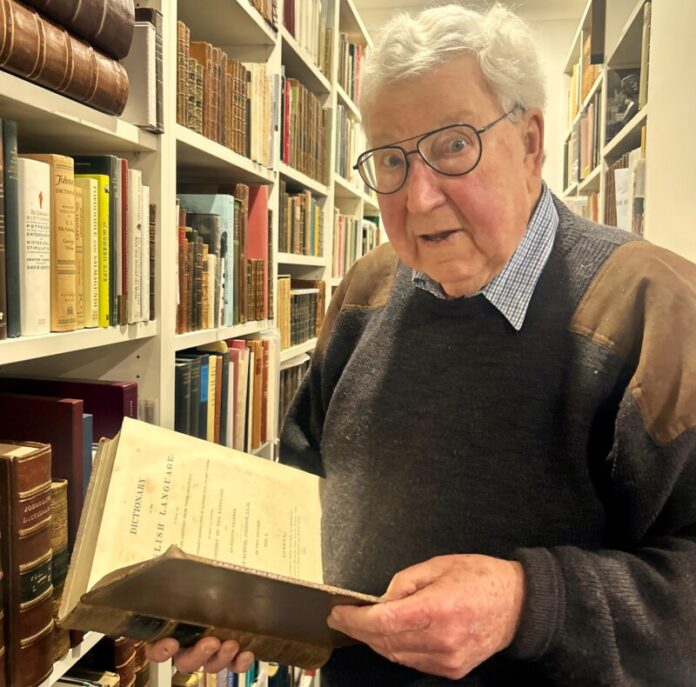
A bibliophile of epic proportions, John’s private library of thousands of tomes and novels is a sight to behold.
He has the world’s second-best private collection of Dr Samuel Johnson (the 18th-century English writer, poet, essayist, and lexicographer who compiled A Dictionary of the English Language in 1755), and he has the biggest private collection of Johnson’s book Rasselas.
John served as President of the Johnson Society in England, America and Australia. He has been Governor of Johnson House and a trustee for nearly 30 years and has lectured widely on the topic.
“He is a beautiful writer, but the main thing for me is the collecting,” he said.
John discovered his first Samuel Johnson book in the early ’60s.
Studying law in Western Australia on a scholarship, John was given a book allowance of 100 pounds a year through the program.
“I failed to tell my parents about it, so my dad gave me 100 pounds a year for books, which I would then spend at the university bookshop,” he said.
“I wanted some leather books, so I went to a clearing house auction in Bendigo.
“There were these brightly coloured books bound up in a bundle of four, and there were three deadly boring bits of Victorian theology and this little tiny copy of Rasselas.”
While John is planning the next stage for his collection, with much of his Rasselas collection to go to Johnson’s school, Pembrook College in Oxford and many to other institutions, he is still busy collecting, with a minimum of four or five new books arriving each week.
Growing up in Bendigo, John’s parents were both avid readers and collectors. His father collected pewter and his mother, fine china tea sets.
“I was very influenced by the lady who ran the local children’s library, Ms Tanner. She was a fearsome old girl; a lot of people were frightened of her, but I got along really well with her. She encouraged my reading, as did my parents,” John said.
“When I was 14-15, she said, ‘You’ve read everything here,’ and she got me special access and membership at the adults’ library, which was then in a basement below the Shamrock Hotel.”
Finishing school in 1960, John, who couldn’t wait to get out of Bendigo, went to Melbourne to work for 12 months while he figured out his next step.
A memorable trip to Western Australia and the university there a few years earlier led him to contact them.
“They said it was a really big class. I asked how many; they said, ’42’. I asked, ‘Can I be 43?’ I started the following Tuesday,” he said.
“I went over there with the idea of staying for 12 months and then coming back and transferring to Melbourne University, but after three months I rang my parents up and said, ‘I’m never leaving here.’
“I won the scholarship at the end of my first year. I was living on campus, and I met a whole lot of really interesting people. I became involved in student politics and was elected to Guild Council. I had a wonderful university life. I couldn’t believe my good luck.”
After completing his four-year degree and two years’ articles, John and a few others started a practice.
“I went down and hung up my shingle in Esperance. I was the only lawyer on the south coast of Australia between Port Lincoln in the East and Albany in the West,” he said.
“I was there for the huge boom, when all the overseas investors came in, particularly from America, buying land and so on. And I was there for the first nickel boom.”
Every summer during his studies, John would return to Bendigo to work for three months.
“I used to come back to the farm in Mitiamo. I’d see the harvest done and then I’d work on the railways,” he said.
“I rose to the dizzying heights of acting station master at Golden Square! I started working in the Goods Sheds, then they moved me onto the station itself, doing the parcels and newspapers to and from Melbourne.”
The second installment of John’s two-part interview will be published in next Friday’s Castlemaine Mail on October 16.