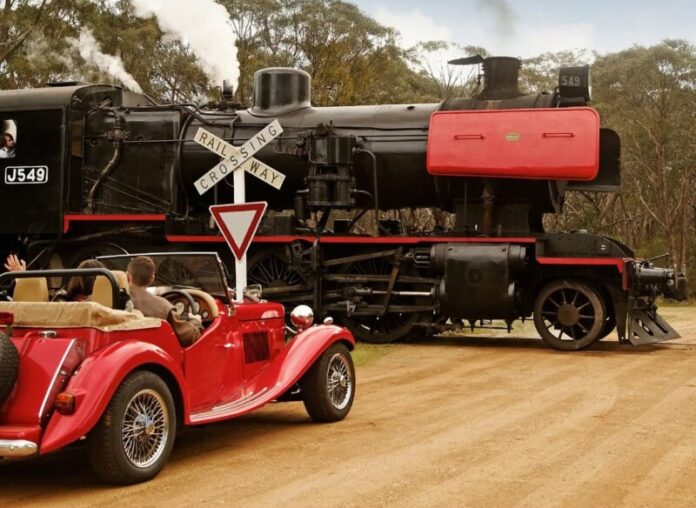
A truly special milestone in Victorian rail preservation — marking 40 years since the re-opening of the first stage of the then Castlemaine and Maldon Railway on March 29 1986, now proudly known as the Victorian Goldfields Railway.
From humble beginnings driven by passionate volunteers, to becoming a much-loved part of the Mount Alexander region, this railway stands as a testament to dedication, community spirit and a shared love of preserving history.
What began as a gold rush story in the 1850s evolved into a vital branch line connecting communities before closing in 1976. Thanks to the vision of the Castlemaine and Maldon Railway Preservation Society and years of tireless work, the line was brought back to life — with K160 proudly leading the very first trains once again.
The celebration on Saturday March 29, honoured not just the railway, but the people behind it — including a wonderful group of past office bearers and volunteers who have helped shape the VGR into what it is today.
40 years of Castlemaine and Maldon Railway

Ellery Family gather at Chewton

On March 21, 55 descendants of John and Ann Ellery (nee George) gathered at the Chewton Senior Citizens Centre.
Joyce Bartlett, the great, great granddaughter of John and Ann Ellery kindly shared some information about the reunion and family history.
This was the second attempt at a reunion, with the first coinciding with the Ravenswood-Harcourt bushfires on January 10. There were only
eight people on that occasion, with descendants of Mary Jane and Josiah meeting for the first time. Descendants of John and Ann now live in many parts of Australia and overseas.
John and Ann Ellery, natives of St Columb Minor, Cornwall, England, arrived at Port Melbourne, Victoria, aboard the ‘Prince Alfred’ on February, 17, 1854, in the midst of the Victorian gold rush, with six of their children. Gold mining features as an occupation of many of the family, but John and Ann settled in Faraday as farmers.
John and Ann had eight children, Silas, Elizabeth, John Jnr, Mary Jane, Josiah, Catherine, Ellen and Silas. (Their first born, 17 year old Silas, was drowned in 1846 in the worst historical Cornish mining disaster – the East Wheal Rose lead mine near Newquay, along with 38 others. The mine flooded when it was hit by a thunderstorm nearby (reported as a cloud burst).
Their eldest daughter Elizabeth married Josiah Inch in Cornwall in 1852. When they were both 21 (along with Josiah’s sister Tamsen), they sailed from Liverpool, England in late 1852 (it had left Liverpool in August 1852) on the now notorious double decked clipper ‘Triconderoga’ (starting with a total of 800 sailors and immigrants), and dropped anchor off the beach at the historic Portsea Quarantine station (Point Nepean), full of scarlett fever
and typhoid. 100 of the passengers and some crew died enroute to Australia, with a further 90 dying at Point Nepean (Portsea). This in itself is an interesting and intriguing story!
Other marriages in the family took place in Central Victoria – John to Isabella Montgomery in 1867, Mary Jane firstly to William Lewis in 1857 and then Thomas Metcalf in 1862; Catherine to William Lawry in 1860; Josiah to Elizabeth Bolitho in 1868; Ellen to Henry Tonkin in 1870 and Silas to Catherine Thomas in 1878.
John died in 1870 and is buried at the Chewton Cemetery, with his youngest son Silas who died in 1879 and a grandson Thomas Alfred Ellery, a son of John Jnr. who died in 1874.
Daughter, Elizabeth is also buried at Chewton. John’s wife Ann, died in 1891 at the home of her daughter, Ellen Tonkin and is buried with members of the Metcalf family at the Melbourne Central Cemetery. Many descendants of John and Ann are also interred at Chewton.
The day included a tour of Faraday and Chewton to visit significant sites, including Boyle’s Inn, the Faraday school, the site of the original house at the foot of Mt Alexander and finally, the Chewton Cemetery.
It was a noteworthy gathering for the wider Ellery family and many connections were made on the day.
Committed to community

Bold plan launched

A new initiative that would allow people living in Tiny Homes on Wheels (THOW) to become property caretakers was launched last Tuesday at a My Home Network information session in Castlemaine.
ore than 40 attendees, including THOW owners and builders, property managers, collective housing experts, and representatives from public housing and land grant organisations, heard about a successful four-year pilot in Melbourne. In that project, an off-grid THOW resident transformed a derelict block into a productive community garden.
Building on this proven example, the My Home Network THOW Working Group has developed a practical model to match THOW owners with secure sites on commercial, industrial, residential, farming, or community properties. In return, caretakers would provide light property maintenance, general oversight, and appropriate bushfire risk reduction, helping to activate and improve the function of the land.
Research and the Melbourne pilot demonstrate that THOW can qualify as long-term, habitable dwellings under existing caretaker residence provisions. The proposed model also includes strong governance options, with community or committee support structures to ensure the arrangement works for people of all ages and life situations.
The next step is to engage with interested land managers and property owners to refine caretaker duties and develop a pilot trial in the shire.
Tom Danby from the My Home Network THOW Working Group, who is leading the project, said it was great to see so many people interested and the collective expertise in the room. “This model is really about affordable housing, building community and caring for places. A win-win for everyone,” he said.
For more information, contact Tom Danby via email at twdanby@gmail.com or phone 0425 711 935.
Tom’s shed
John Ellis
“I could not believe it when Lance and Debbie turned up at my new place with a shed! I was speechless and didn’t know what to say. I can only say thank you to all of you for helping me out – and I can tell you I will be spending many happy hours in that shed as I still love working with wood. And even more thanks for my new belt sander that is already being put to good use! I am over the moon,” Tom Taft wrote to the Chewton Chat.
Tom is a woodworker and a timber aficionado from way back. And it’s always inspirational to see the projects he’s been working on, be it constructing or carving. The boxes he’s created as gifts or donated as raffle prizes, the chess sets, the birds, the horses, the music boxes, the green men, the clocks, the redeemers – and the list goes on!
Tom was moving house and had a carport of woodworking tools that there was no space for at his new house. A problem? It sure was for a moment, until the community stepped up.
The Chewton Domain Society agreed to receive donations for ‘Tom’s Shed’, so appeals went out. That was on a Thursday, they had the shed cost covered by Friday, the shed was purchased on Saturday, and Tom moved in on Monday.
After those few hectic days, the shed was planned to be erected on Tuesday… but three pieces were missing from the flatpack!
Those parts have since arrived, Debra Tranter and Lance Bell have put the shed up, the tools are locked in safely, and Tom is as happy as a dog with two tails! As is everyone who helped with the ‘shed problem.’
And just when you think things couldn’t be better – they suddenly were! Collectively, the society had raised $1,140.00 so there was money left over. Tom’s old belt sander was on its last legs, so Mount Alexander Hardware was visited, and Tom took a new belt sander back to the shed. Everyone is now looking forward to seeing what comes out of that shed in future, because Tom is full of surprises! Creative surprises!
Leadership which enabled
Hans Paas, Castlemaine
I note from the Mayor’s most recent ‘newsy’ message that our CEO Darren Fuzzard is moving on after around ten years at the helm of our amazing shire. From the outset this man showed how a skill set that did not fit so neatly into this kind of executive role was going to lead to a very significant change of pace for this local government.
Some of us felt battered by the experience with his predecessor and prayed that this community might get a different kind of leadership. Prayers were answered. Instead of a leadership that emphasised power and authority we saw leadership which enabled. The relationship between the elected leadership and the appointed people began to shift with a focus on building community co-operation rather than confrontation.
We are all very fortunate to live in such a caring community. Apparently the 3450 postcode is the most charitable in the nation. We are also fortunate that it is this council made up of committed and focussed people who have the example of the last ten years and will be able to search for someone who will continue to build teamwork and initiative in an atmosphere of encouragement and respect.
And that’s a wrap!