
The first installment of Peter’s interview was published in last week’s Mail on Friday November 21.
“I feel privileged to have the opportunity for this career.”
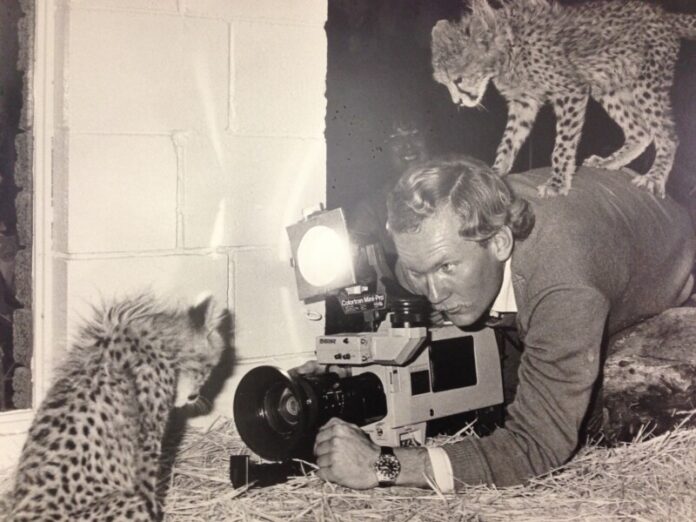
Peter’s career as a cameraman spans almost five decades, and has seen him travel the world, witnessing untold beauty but also poverty, tragedy, conflicts and wars, and at times, has even put his own life in danger.
He tells stories of being behind the camera during historical events that most of the world has only witnessed in their living rooms through a television screen. He snuck into Moscow during the uprising, when Yeltsin blew up Parliament, listening to the sounds of Kalashnikovs being fired.
In 1994, Peter caught a cargo plane into Goma when the Tutsi and Hutu ethnic groups had their meltdown. He describes the Hutu refugee camps as being one of the most difficult things he has seen.”You go into a camp of 450,000 people, and there are several of these around the shanty town of Goma. I would walk in there and acknowledge the people around me – they don’t speak English, and I don’t speak their native tongue, so it’s just a nod of the head. The interesting thing was, the tree branches and everything that could be burnt were being denuded because the refugees were using fires to boil water in little billies.
“On another occasion, I was at a refugee camp, where there was a young boy, about seven, watching his father die of cholera, and behind the father, there were rows of bodies, about five high, creating a wall, because cholera had killed so many people,” he said.
A situation at an aid station for orphan kids in Goma also sticks in Peter’s mind.
“There was a New Zealand aid worker we were doing a profile on as part of a telethon for Television NZ. I asked her to walk towards me as she was absorbing and taking in the human tragedy unfolding around us. After she’d taken a few steps, she found a newly born baby among the rocks. She picked it up and put her finger in its mouth, and it started to suck. The child was alive. I was proud when we were later told that when the story went to air during the telethon, the shot of the baby being rescued by the aid worker raised a million dollars.”In 1999, Peter left Channel 9 and got into four-wheel-drive action filming. Working in this field during a time that was pre-drones and GoPros, Peter describes it as ‘arduous’, but ‘a great series of adventures’.
During his career, Peter also captured wildlife, including gorillas, platypus, dingoes, reindeer in Finland and even wild yak in Tibet!
Peter and his wife Jocelyn moved to Castlemaine six years ago, once her teaching career finished and she moved into a career in travel writing. Peter, who at the time was working for a second time at Channel 9, and was then aged 61, felt it was time to make the tree change.
“This is the time in our lives when we are young enough to move on and enjoy it. We’d been kicking tyres for about three years when we came across the house in Castlemaine. As soon as I saw it, I thought, ‘Wow! This is it.”
And the all-important questions:
What hobbies do you enjoy? I love gardening. In Melbourne, we had a garden that I could mow the lawns in about two minutes. This one is a bit of a challenge, but I love it, and I love the change of seasons. I’m part of U3A, I run the secret men’s group there. We love riding our bikes on the trails. We can cycle up to Maldon, have a hot chocolate, and come home again.
What are you reading at the moment? From Antarctica to the Gold Rush – in the wake of the Erebus by a bloke called Alexander Smith.
Who are your three dream dinner guests? Surveyor, William John Wills, from the Burke and Wills expedition, because it would be interesting to understand the history from an early British explorer’s perspective. Our friend Glen Taylor who is a sixth-generation local, I’m enthralled by his stories of growing up in Castlemaine. The other person is from U3A, David Boucher, a brilliant retired historian from Melbourne.
What are your philosophies in life? To enjoy life to the fullest and do the best I can to help others.
Finally, what do you love most about the place you call home? Our hood here is so amazing. Going through COVID was a big watershed time where you would help each other out. When we were out of lockdown, you wanted to reconnect because you’d been isolated, so we’d be having catch-ups whenever we could. We love the culture here. It has all the facilities like the hospital, railway station, easy access to Melbourne as well as great restaurants, cafés and green spaces like the beautiful Botanical Gardens. Then there’s the arts and entertainment scene with plenty of gigs and festivals like the Fringe, State Festival, Town Folk Festival, and the Theatre Royal. The history of the town is important to me. We live in the historical Goldrush camp settlement in a house that was built in 1905 by a renowned local architect.