
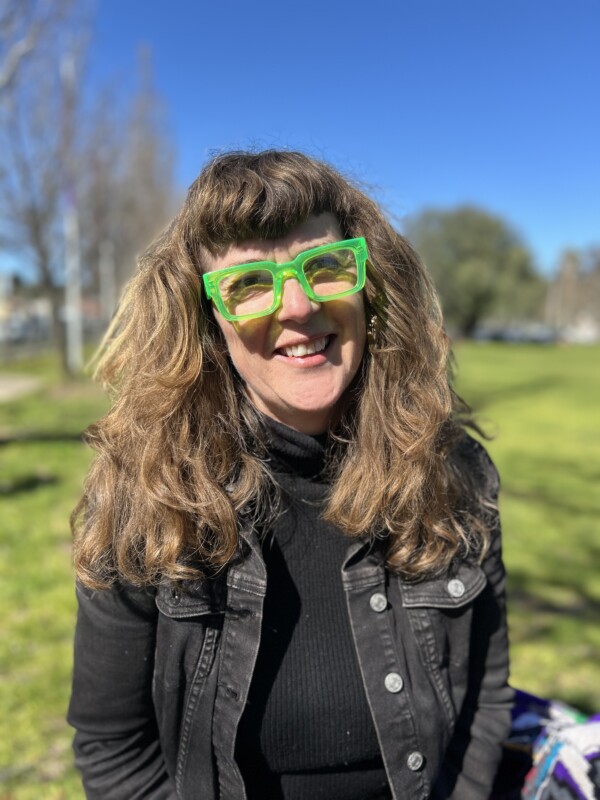
At 17, Hayley left her home in the Dandenong Ranges and headed to the city to study. Her university career began with languages, then moved to furniture design before finally settling on a degree in sculpture. She’s worked as an artist ever since.
“Going straight from high school to Monash uni, I just protested and drank lots of beer for the first two years. Oh, and I joined the radio station,” she said.
After finishing uni, Hayley moved to Darwin, where she managed an artist-run space for eight years and had her child.
When her daughter was eight months old, she applied for a three-month Australian Council Residency in London.
“I didn’t tell them I had a baby when I applied, because I thought it might be something that would put me down the list. When I got the residency, I said, ‘By the way, I’ve got a baby.’
“If you still want to continue with your practice and learn and develop your practice, then your child just has to be part of it.”
Hayley fondly recalls taking her daughter and her husband at the time on a three-month residency in Senegal in West Africa.
“I wanted to go somewhere where I could speak French, and at three she was such a sponge. It was great for her. We were living in St Louis, the old French Port from the old colonies, and it’s a UNESCO heritage town. It was amazing. It was small, and she would just run around the streets with a little friend she met.
“She’s 16 now.”
Over the years, Hayley’s art began shifting towards focusing on death and dying.
“I think I worked out that I had seven significant deaths before I reached 40,” she said.
“I had a sister who died when she was three, and I was six. I had an uncle; he was 21 and had just emigrated to Australia, and he died drink-driving. My grandfather died, and I had two friends who died by suicide. Dad died when I was in my 20s, and mum died when I was in my 30s.
“The theme of death started creeping into my art practice after Dad died, which was around the time that I graduated from sculpture.”
Attending RMIT in the 90s, Hayley said their studio space was basically a classroom shared with other people – there weren’t big studio spaces, like they had at VCA.
“We had to think very conceptually and present work in stairwells, toilets and on the rooftop and that kind of thing, so I had that ideology as part of my practice,” she said.
“Installation, conceptual art and then death as a theme grew from there.”
The family moved to the Blue Mountains for three years, which Hayley describes as being “horrible for various reasons.” Not knowing anyone and struggling to find work, she decided to do her master’s in research in visual arts.
“This was in 2012, about 15 years after I finished studying. I got a scholarship to feed the family and started researching the funeral and death industry,” she said.
“That’s when I first came across the concept of a death cafe. I found one in the Blue Mountains. I went along, and I had this epiphany. It was so amazing to be around people who wanted to talk about death and dying.
“Originally, I went with this idea that I would use it for research for my master’s, and I had a series of questions like: what do you do with stuff people leave behind when someone dies? “But when I was there, I realised it was just a really beautiful space to talk openly about anything. I was totally amazed.”
Hayley ended up befriending the host Dr Kerrie Noonen (who was instrumental in the death literacy movement) and co-hosting death cafes with her. Kerrie also helped Hayley get a job at Penrith University working on an end-of-life project with Compassionate Communities.
“I kind of went full bore into it and became a death literacy advocate,” she said.
Hayley described being death literate as being informed and understanding that there is a choice in end-of-life and post-death care.
“If you’re a little bit death literate, you know you don’t have to have a coffin. You can ask the funeral director for a shrouded burial,” she said.
“You can have a shrouded burial or cremation anywhere, but if you want to have a natural burial ground, the only choice around here is Chewton Cemetery. They have a dedicated area up the back which is dedicated to natural burials. No embalming, no plastics, no brass handles on coffins; you’re generally just in a shroud with no polyester clothing underneath.”
Hayley and her family moved to Castlemaine in 2015. She co-hosted death cafes locally for 10 years before COVID brought them to a halt.
After working at La Trobe University as a librarian for 10 years, Hayley began part-time in the visual arts department. A mechanic friend bought her a hearse, and earlier this year she decided it was time to start her own business as an independent death worker.
The second installment of Hayley’s two-part interview will be published in next Friday’s Mail on October 2.